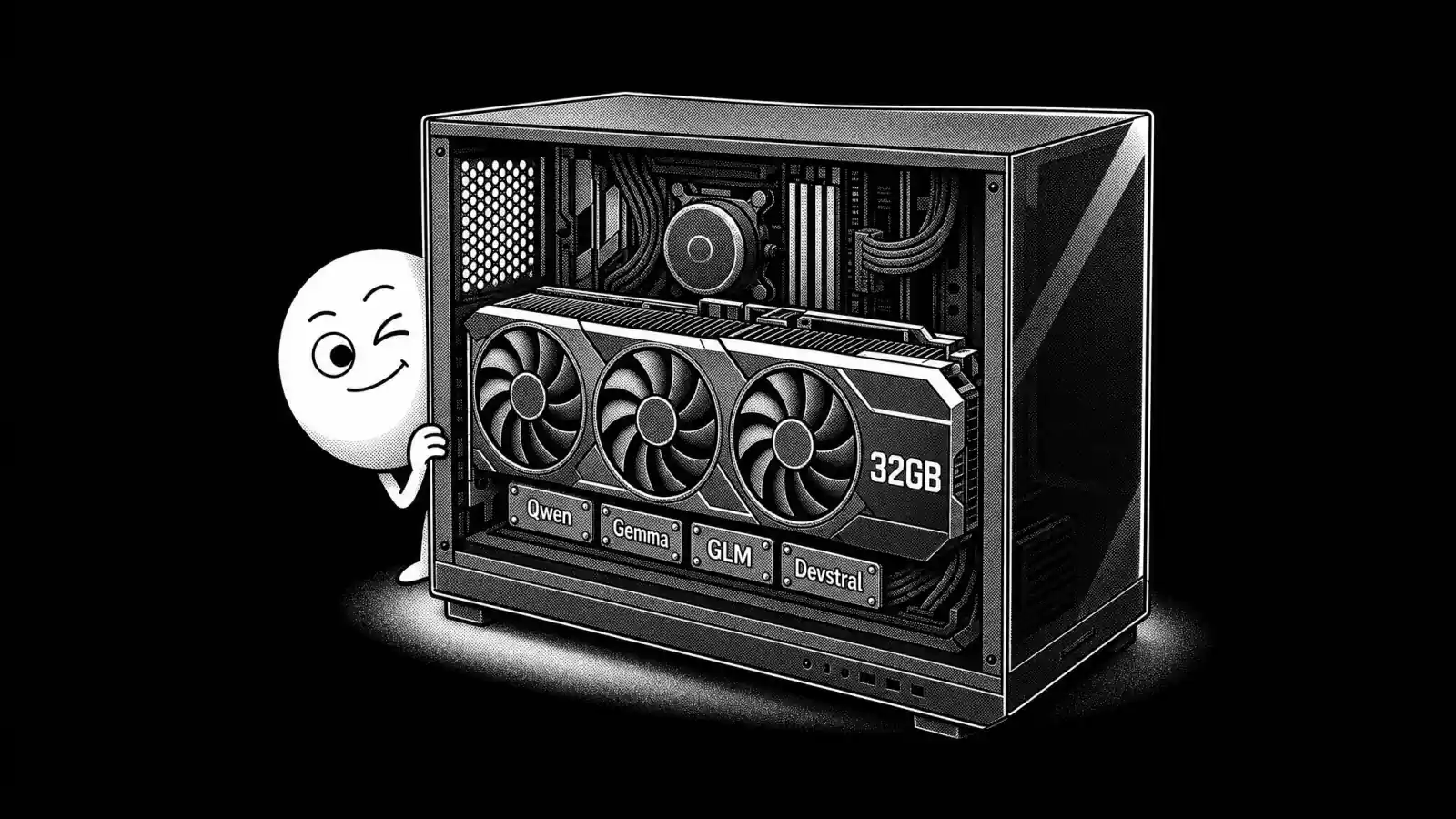

Owners of 32GB graphics cards can now run local AI models that rival proprietary flagships from just a couple of years ago. This guide selects the strongest current LLMs for either 32GB of dedicated VRAM or a 32GB unified-memory pool.
Selection criteria
We prioritized recent open-weight models that meet four conditions:
- The recommended build fits without routine CPU offload on a 32GB GPU, or without swap on a reasonably clean 32GB shared-memory system.
- The quantization is Q4-quality or better.
- The model has a clear strength in general use, coding, tools, long context, or multimodal work.
- A current local runtime such as Atomic Chat, llama.cpp, Ollama, LM Studio, MLX, vLLM, or SGLang can run it.
| Model | Build for 32GB VRAM | Build for 32GB total / unified memory | Best for | Main limitation |
|---|---|---|---|---|
| Qwen 3.6 35B-A3B | Q5_K_M, 24.7GB | Q4_K_M, 21.2GB | Best overall | Recommended GGUF is text-only |
| NVIDIA Nemotron 3.5 Lightning 30B-A3B | Q5_K_M, 26.6GB | AD-IQ4_NL, 19.7GB | Fast long-context agents | Text-only and needs a recent runtime |
| Muse Glimmer 30B | AD-IQ4_XS + vision + DFlash, about 24.6GB loaded | AD-IQ4_XS + vision, about 19.9GB | Multimodal agents | Several files in the complete setup |
| GLM-4.7-Flash 30B-A3B | Q6_K, 24.8GB | Q5_K_M, 21.6GB | Reasoning and tool use | Text-only; thinking can be verbose |
| Gemma 4 31B | Q6_K, 25.2GB | Q5_K_M, 21.8GB | Dense multimodal generalist | More compute per token than an MoE |
| Devstral Small 2 24B | Q8_0, 25.1GB | Q6_K, 19.4GB | Local coding agents | Narrower general-purpose ability |
Best Local LLMs for 32GB
Qwen 3.6 35B-A3B
Qwen 3.6 35B-A3B is a 35B-parameter multimodal mixture-of-experts model with about 3B parameters active per token. It combines Gated DeltaNet linear-attention blocks with conventional gated-attention blocks to reduce generation compute and KV-cache growth.
| Model fact | Value |
|---|---|
| Developer | Alibaba, Qwen team |
| Parameter count | 35B stored; approximately 3B used for each token |
| Architecture | Hybrid Gated DeltaNet / gated attention MoE |
| Layers | 40 |
| Experts | 256 routed, 8 active plus 1 shared |
| Context window | 262,144 tokens natively; YaRN can extend it to 1,010,000 |
| 32GB VRAM choice | Q5_K_M, 24.7GB |
| 32GB shared-memory choice | Q4_K_M, 21.2GB |
| Higher-fidelity alternative | Q6_K, 28.5GB; practical with moderate context but less safety margin |
| Input support | The cited GGUF handles text; Qwen's original checkpoint also accepts images |
| Thinking | Thinking and non-thinking modes; optional preserved thinking across turns |
| Terms | Apache License 2.0 |
For a 32GB GPU, we recommend the 24.7GB Q5_K_M build from AtomicChat/Qwen3.6-35B-A3B-GGUF. It is an importance-matrix quant built directly from Qwen's weights. If you have 32GB of unified memory, use Q4_K_M at 21.2GB.
The base model accepts text and images, but the Atomic Chat GGUF repository is currently text-only and does not include a vision projector. Use an original or multimodal-compatible build if image input is essential.
Qwen 3.6 35B-A3B benchmarks
| Benchmark | Score |
|---|---|
| GPQA | 86.0 |
| MMLU-Pro | 85.2 |
| AIME 2026 | 92.7 |
| LiveCodeBench v6 | 80.4 |
| SWE-bench Verified | 73.4 |
| SWE-bench Pro | 49.5 |
| Terminal-Bench 2.0 | 51.5 |
| MCP-Atlas | 62.8 |
| MMMU | 81.7 |
The numbers above are published for the full-precision base model. Quantized performance will be somewhat lower, but at Q5_K_M it won't make a practical difference.
Qwen 3.6 35B-A3B pros
- Strong balance of reasoning, coding, tools, research, and multilingual use
- Only about 3B parameters active per token
- Q5_K_M leaves more than 7GB of nominal capacity before runtime allocations
- Hybrid attention keeps context memory more manageable than a conventional 35B transformer
- Permissive Apache licensing
Qwen 3.6 35B-A3B cons
- Atomic Chat's GGUF is text-only even though the base model is multimodal
- Produces malformed turns if the Qwen Jinja template is not enabled
- Thinking mode can produce long responses and use many tokens
When to choose Qwen 3.6 35B-A3B: Pick it when one model needs to cover writing, analysis, code, tools, and multilingual work.
NVIDIA Nemotron 3.5 Lightning 30B-A3B
NVIDIA Nemotron 3.5 Lightning 30B-A3B is a 30B-parameter hybrid MoE model released in August 2026. It activates roughly 3B parameters for each generated token. The 52-layer architecture uses 23 Mamba-2 layers, 23 MoE layers, and six full-attention layers.
| Model fact | Value |
|---|---|
| Developer | NVIDIA |
| Parameter count | 30B stored; roughly 3B active per token |
| Architecture | Hybrid Mamba-2, attention, and MoE |
| Layers | 52: 23 Mamba-2, 23 MoE, 6 attention |
| Experts | 128 routed, 6 active plus 1 shared |
| Context | 262K in local GGUF use; architecture supports up to 1M |
| KV cache | About 6KB per token in llama.cpp |
| 32GB VRAM choice | Q5_K_M, 26.6GB |
| 32GB shared-memory choice | AD-IQ4_NL, 19.7GB |
| Inputs | Text |
| Thinking | Configurable on or off |
| License | OpenMDW 1.1 |
The small KV cache is one of the model's more useful characteristics for local inference. Its six attention layers use only two KV heads, bringing KV-cache usage in llama.cpp to roughly 6KB per token. At 32K context, that works out to about 192MB before runtime overhead. The Mamba state, unlike the attention cache, stays roughly constant as context grows.
If you have a 32GB GPU, download the 26.6GB Q5_K_M build from AtomicChat/NVIDIA-Nemotron-3.5-Lightning-30B-A3B-GGUF.
The 19.7GB AD-IQ4_NL build is more useful when you need memory left over. Atomic Chat measured divergence close to the larger Q5_K_M quant, so you give up very little fidelity.
Nemotron 3.5 Lightning benchmarks
| Benchmark | Score |
|---|---|
| MMLU-Pro | 81.94 |
| GPQA Diamond | 75.44 |
| SWE-bench Verified | 51.56 |
| SWE-bench Multilingual | 39.33 |
| Terminal-Bench 2.1 | 24.58 |
| BrowseComp | 36.97 |
| IFBench (loose) | 71.88 |
| AA-LCR long context | 52.00 |
Nemotron 3.5 Lightning pros
- Very low KV-cache growth for a 30B model
- Fast MoE generation with only 3B active parameters
- Designed for agents, tool calls, structured output, and long-range retrieval
- Thinking can be disabled for quick responses
- Multiple measured quant options between 19.7GB and 28.8GB
Nemotron 3.5 Lightning cons
- Text-only
- General reasoning and coding scores trail Qwen 3.6
- Requires a recent llama.cpp build for the
nemotron_h_moearchitecture - OpenMDW terms require more review than the familiar permissive licenses
- Speculative decoding can reduce speed under full GPU offload, so it should be benchmarked rather than enabled automatically
When to choose Nemotron 3.5 Lightning: Pick it for long-context RAG, tool-heavy assistants, or agent loops.
Muse Glimmer 30B
Muse Glimmer 30B is a local AI agentic model by Meta. It was released in August 2026. It combines a 30B causal language model with a separate perception encoder for screenshots, charts, documents, and other visual inputs. The model is trained around end-to-end task completion, including tool use and recovery when an attempted action fails.
| Model fact | Value |
|---|---|
| Developer | Meta Superintelligence Lab |
| Parameters | 30B language model plus dedicated perception encoder |
| Architecture | Dense causal model with gated attention and a separate vision encoder |
| Context | 128K in released local packages |
| 32GB VRAM choice | AD-IQ4_XS + vision projector + DFlash, about 24.6GB loaded |
| 32GB shared-memory choice | AD-IQ4_XS + vision projector, about 19.9GB |
| Measured generation | 71.8 tokens/s with DFlash on RTX 5090 at 16K context |
| Inputs | Text and images |
| Tool use | Function calling and multi-step agent workflows |
| Reasoning | Low, medium, high, and xhigh through the system prompt |
| Terms | Apache License 2.0 |
For a 32GB GPU, use the 16.0GB AD-IQ4_XS build from Atomic Chat with the 3.9GB vision projector and 5.1GB DFlash drafter. Atomic Chat measured the complete stack at about 24.6GB on an RTX 5090.
If you have a 32GB unified-memory computer, use the same AD-IQ4_XS model and vision projector but leave out DFlash. That reduces the base multimodal setup to about 19.9GB before context and runtime memory, giving macOS and Windows substantially more headroom.
DFlash matters mainly for speed. Atomic Chat measured the model with its vision encoder at 39.6 tokens per second, rising to 71.8 tokens per second with the speculative drafter enabled.
Muse Glimmer 30B benchmarks
| Benchmark | Score |
|---|---|
| GPQA Diamond | 83.5 |
| AIME 2026 | 94.7 |
| SWE-bench Verified | 76.0 |
| SWE-bench Pro | 51.2 |
Muse Glimmer 30B pros
- Recent model built specifically for local autonomous agents
- Native screenshot, chart, and document understanding
- Strong coding and reasoning scores for a consumer-hardware model
- Full model, vision encoder, and speculative drafter fit together in 32GB VRAM
- DFlash can materially accelerate generation without changing verified output
- Permissive Apache licensing
Muse Glimmer 30B cons
- Requires three files for the fastest multimodal configuration
- Needs a very recent llama.cpp build with Muse Glimmer support
- The 29.6GB Q8 text model leaves no practical room for vision
- High default reasoning depth can consume the entire output budget on short requests
When to choose Muse Glimmer 30B: If you need an offline agent that must inspect screenshots and read charts or documents.
GLM-4.7-Flash 30B-A3B
GLM-4.7-Flash is a 30B-A3B MoE model for reasoning, coding, browsing, and multi-turn tool use. Each generated token engages roughly 3B of its parameters.
| Model fact | Value |
|---|---|
| Developer | Z.ai / GLM team |
| Parameter count | Around 30B stored, with 3B selected for each token |
| Architecture | MoE with 64 routed experts, 4 active per token |
| Layers | 47 |
| Native context | 202,752 tokens |
| 32GB VRAM choice | Q6_K, 24.83GB |
| 32GB shared-memory choice | Q5_K_M, 21.57GB |
| Inputs | Text |
| Thinking | Standard and preserved-thinking modes |
| Tool use | Function calling and agentic workflows |
| License | MIT |
For a dedicated 32GB GPU, use the 24.8GB Q6_K build from bartowski/zai-org_GLM-4.7-Flash-GGUF. It fits within 32GB while leaving several gigabytes for context and runtime allocations.
On a 32GB shared-memory computer, Q5_K_M uses 21.6GB. This leaves about 10GB before memory used by the operating system, context, and other applications is counted. The Q4_K_M build is 18.5GB.
GLM-4.7-Flash can retain thinking tokens across turns during longer agent tasks. Later turns can therefore refer to reasoning produced earlier in the same task. Those tokens also remain in the context window, so long reasoning traces increase context usage. If you use the model for ordinary chat or short tasks, you can disable or limit thinking to avoid carrying that additional context.
GLM-4.7-Flash benchmarks
| Benchmark | Score |
|---|---|
| AIME 2025 | 91.6 |
| GPQA | 75.2 |
| LiveCodeBench v6 | 64.0 |
| HLE | 14.4 |
| SWE-bench Verified | 59.2 |
| Tau2-Bench | 79.5 |
| BrowseComp | 42.8 |
GLM-4.7-Flash pros
- Strong reasoning and tool performance for its active size
- Q5_K_M leaves usable headroom in 32GB of total memory
- MoE compute is practical on unified memory and CPU-heavy systems
- Preserved thinking helps multi-turn agents
- MIT license
GLM-4.7-Flash cons
- Text-only
- Full 202K context is not realistic on a 32GB computer
- Requires correct reasoning and tool-call parsing
- Preserved thinking can grow the active context quickly
- Recent runtime builds may be necessary for correct architecture support
When to choose GLM-4.7-Flash: For reasoning, coding, and multi-turn tools without the compute cost of a dense model.
Gemma 4 31B
Gemma 4 31B is Google's 30.7B-parameter dense multimodal model. It has 60 layers and alternates 1,024-token sliding-window attention with global attention. Unlike an MoE model, it uses all of its parameters during generation.
| Model fact | Value |
|---|---|
| Developer | Google DeepMind |
| Parameters | 30.7B |
| Architecture | Dense decoder with hybrid sliding-window and global attention |
| Layers | 60 |
| Maximum trained context | 256K tokens |
| Local attention span | 1,024 tokens between global-attention layers |
| 32GB VRAM choice | Q6_K, 25.2GB |
| 32GB shared-memory choice | Q5_K_M, 21.8GB |
| Inputs | Text and images |
| Vision projector | Included in the Atomic Chat GGUF repository |
| Terms | Apache License 2.0 |
- For a dedicated 32GB GPU, use the 25.2GB
Q6_Kbuild from AtomicChat/gemma-4-31B-it-GGUF. - On a 32GB unified-memory computer, use
Q5_K_Mat 21.8GB.
The GGUF release includes a separate vision projector, so you can use images and documents as well as text.
Gemma 4 31B benchmarks
| Benchmark | Score |
|---|---|
| MMLU-Pro | 85.2 |
| GPQA | 84.3 |
| AIME 2026 | 89.2 |
| LiveCodeBench v6 | 80.0 |
| SWE-bench Verified | 52.0 |
| Terminal-Bench 2.0 | 42.9 |
| MMMU | 80.4 |
| MMMU-Pro | 76.9 |
Gemma 4 31B pros
- Strong dense-model reasoning and knowledge performance
- Native image and document understanding
- Q5_K_M fits with useful headroom in 32GB unified memory
- Importance-matrix GGUF built from the original weights
- Permissive Apache licensing
Gemma 4 31B cons
- Activates all 30.7B parameters for every token
- Slower on CPU and lower-bandwidth unified-memory systems than 3B-active MoE models
- Multimodal input and the vision projector consume additional memory
- Requires the correct Gemma 4 Jinja template
- Its nominal 256K window cannot be filled practically within this memory budget
When to choose Gemma 4 31B: If you prefer a dense model or regularly work with screenshots, diagrams, and documents.
Devstral Small 2 24B
Devstral Small 2 24B is Mistral AI's 24B-parameter model for software engineering agents. It is based on Mistral Small 3.1 and is trained for repository-scale work.
| Model fact | Value |
|---|---|
| Developer | Mistral AI |
| Parameters | 24B |
| Architecture | Dense Mistral 3 model with scalable-softmax attention |
| Native context | 262,144 tokens |
| 32GB VRAM choice | Q8_0, 25.06GB |
| 32GB shared-memory choice | Q6_K, 19.35GB |
| Inputs | Text and images |
| Tool use | Mistral function calling and coding-agent scaffolds |
| Terms | Apache License 2.0 |
The language model has 40 layers, with 32 attention heads and eight KV heads. Devstral Small 2 also adds a vision encoder, allowing an agent to inspect screenshots and other visual inputs alongside source code.
Its main use case is long-running software work where the model needs access to tools. Mistral supports it through its own Vibe CLI and lists Cline, Kilo Code, Claude Code, OpenHands, and SWE-Agent among compatible agent scaffolds.
Mistral specifically targets a single RTX 4090 or a Mac with 32GB of memory. If you have a 32GB GPU, use the 25.06GB Q8_0 build from bartowski/mistralai_Devstral-Small-2-24B-Instruct-2512-GGUF. On a 32GB shared-memory computer, use the Q6_K at 19.35GB.
Devstral Small 2 benchmarks
| Benchmark | Score |
|---|---|
| SWE-bench Verified | 68.0 |
| SWE-bench Multilingual | 55.7 |
| Terminal-Bench 2 | 22.5 |
Devstral Small 2 pros
- Built specifically for repository-level software engineering
- Officially targeted at 32GB Macs and single consumer GPUs
- Q6_K leaves enough memory for an IDE and useful repository context
- Supports tools and image input
- Permissive Apache licensing
Devstral Small 2 cons
- Older than the newest August 2026 generalists
- Less versatile for research, writing, and broad agent tasks
- Dense 24B inference can be slower than a 3B-active MoE
- Best results depend on a suitable coding-agent scaffold and system prompt
When to choose Devstral Small 2: For local software engineering.
Frequently Asked Questions
Which LLM is best for 32GB of VRAM?
Qwen 3.6 35B-A3B at Q5_K_M is the best local LLM to run on 32GB VRAM systems. At 24.7GB it fits fully in memory, leaving enough room for runtime buffers and useful context.
Is 32GB RAM enough for an LLM?
Yes, 32GB of VRAM or unified memory is more than enough to run powerful local LLMs. 24B–35B models at Q4 or Q5 can run well when their weight files stay around 19–22GB.
Do I need 32GB of RAM for AI?
No. Smaller local models can be useful with 8GB or 16GB, especially for chat, summarization, and lightweight coding. Moving to 32GB makes stronger 24B–35B models practical and provides more room for context, tools, image components, and other applications.
Can I run a 70B model with 32GB of memory?
In theory you can make it work, but it won't be usable. A dense 70B model needs an extreme low-bit quant, partial CPU offload, or both. This will leave little context headroom and will be painfully slow compared to a 30B–35B model that fits entirely in memory.
Which quant should I use with 32GB?
On 32GB VRAM, you can run Q6–Q5 for a 30B–35B model, and even Q8 for a 24B model. On 32GB shared memory, you can run Q5–Q4.
Bottom line
In this article we've reviewed the best LLMs to run in 2026 on 32GB systems. The good news is that modern AI models that are runnable on that kind of hardware can compete with proprietary flagships from just a few years ago. We'll leave you with a quick summary.
Key Takeaways:
- Qwen 3.6 35B-A3B at Q5_K_M or Q4 is the best AI model to run on 32GB VRAM.
- GLM-4.7-Flash at Q5_K_M is the best LLM to run if your computer has 32GB of total or unified memory.
- In general, on this hardware tier, you can run modern 24B–35B models.
- If you need to use computer vision, consider Muse Glimmer and Gemma 4.
- If you plan to work in large codebases, try Devstral Small 2 or Nemotron 3.5 Lightning.