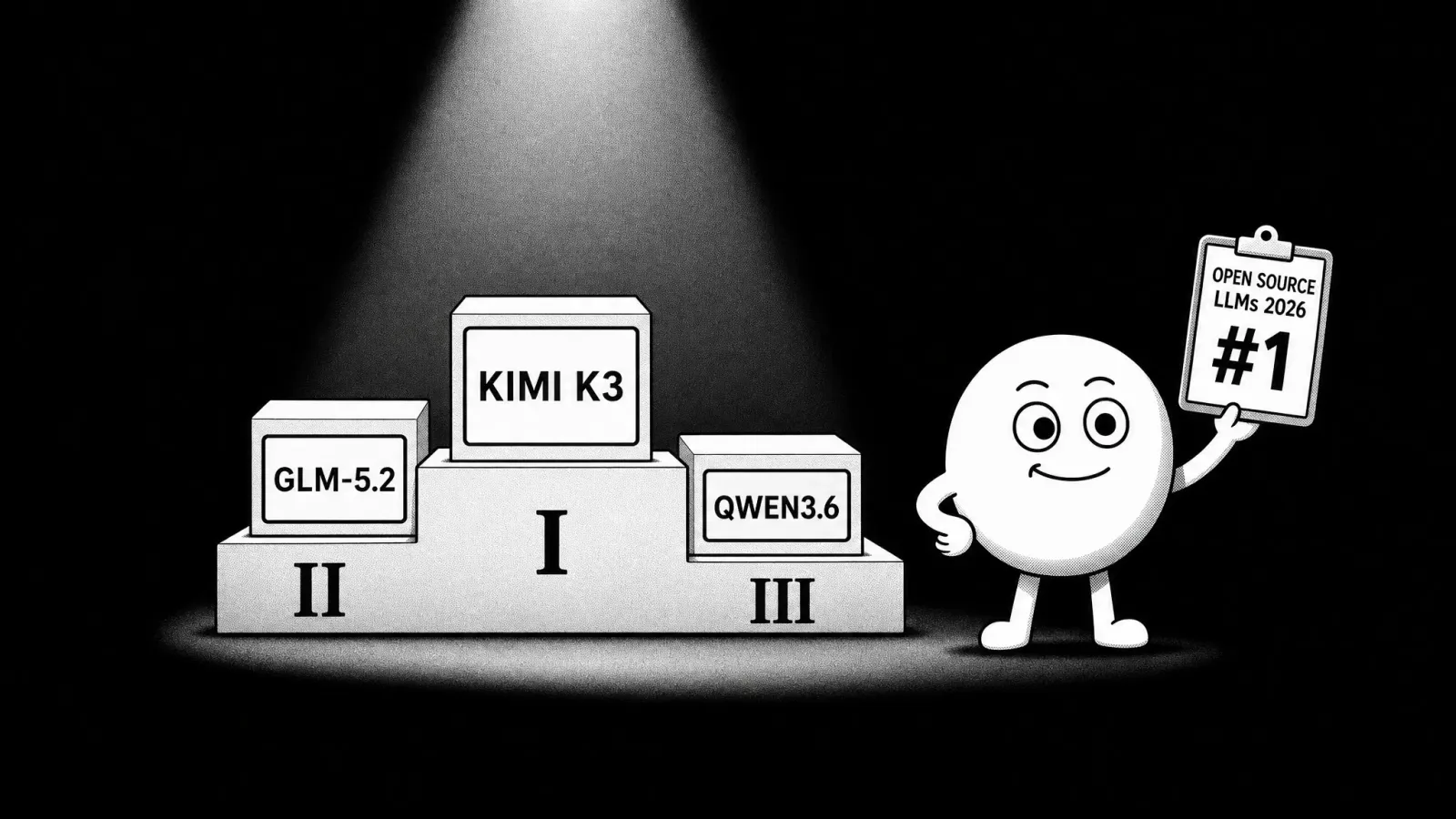

In this article we'll compare the best open source LLMs you can run in 2026 — from small local models to frontier-level AI that trade blows with the best Claude and OpenAI has to offer. Here are the best open source models — and how to run them locally on your machine.
Open source vs open weight models
Before we talk about the best open source models, let's quickly get something out of the way. Strictly speaking, an open source model is a model where the developer has published everything needed to reproduce it, including the weights, training code, and data under a license that lets you use it however you want, including commercially. Very few developers do this.
Instead, they release models as open weights — this is a model in which the developer publishes only the finished weights; however, for all intents and purposes you can freely download the weights, run them locally, and in many cases use the model commercially.
Understanding open source licenses
Additionally, open weight models can come under different licenses. For most users, it doesn't matter which license the model is released under, as most of them permit you to download it, run it, and use it commercially. However, you need to be aware of some nuances, which, admittedly, don't come into play unless the model is used in a highly successful commercial project. The most widespread model licenses are:
- MIT and Apache 2.0 let you use the model commercially, modify it, and ship it in a product with no permission needed. GLM-5.2, DeepSeek-V4, Qwen3.6, Gemma 4, and Hunyuan Hy3 are released under these licenses.
- Modified MIT adds a light condition — attribution once your product passes a revenue or user threshold. Moonshot's Kimi models are released under this license.
- Community licenses allow commercial use but require attribution and, above $20M annual revenue, written authorization from the vendor. MiniMax-M3 models are released under this license.
- Research-only and non-commercial licenses let you download the weights and nothing more. MiniMax-M2.7 was released under this license in March 2026, and community backlash pushed MiniMax to a friendlier community license for the follow-up M3.
What are the best open source LLMs in 2026?
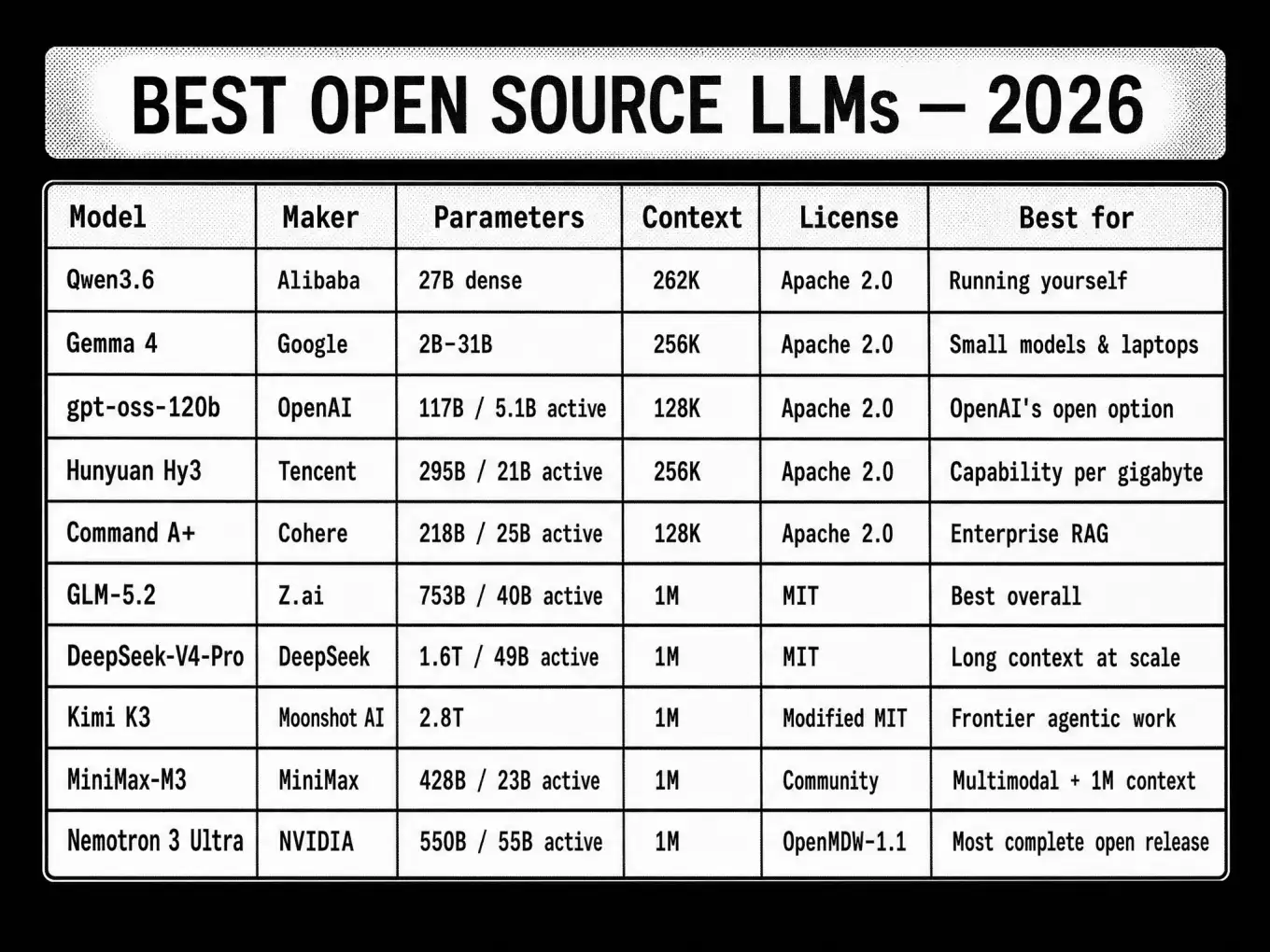
The definition of the best model often comes down to "what is the best model for your use case", so we've made a mix of different model sizes and designs, ordered by how easy they are to run yourself — models that fit on consumer hardware first, datacenter-scale flagships after. We'll explain why each was included in this list in more detail below.
| Model | Developer | Parameters | Context | License | Best for |
|---|---|---|---|---|---|
| Qwen3.6 | Alibaba | 27B dense | 262K | Apache 2.0 | Running yourself |
| Gemma 4 | 2B–31B | 256K | Apache 2.0 | Small models and laptops | |
| gpt-oss-120b | OpenAI | 117B (5.1B active) | 128K | Apache 2.0 | OpenAI's open option |
| Hunyuan Hy3 | Tencent | 295B (21B active) | 256K | Apache 2.0 | Capability per gigabyte |
| Command A+ | Cohere | 218B (25B active) | 128K | Apache 2.0 | Enterprise RAG |
| GLM-5.2 | Z.ai | 753B (40B active) | 1M | MIT | Best overall |
| DeepSeek-V4-Pro | DeepSeek | 1.6T (49B active) | 1M | MIT | Long context at scale |
| Kimi K3 | Moonshot AI | 2.8T | 1M | Modified MIT | Frontier agentic work |
| MiniMax-M3 | MiniMax | 428B (23B active) | 1M | Community | Multimodal + 1M context |
| Nemotron 3 Ultra | NVIDIA | 550B (55B active) | 1M | OpenMDW-1.1 | Most complete open release |
The 10 best open source LLMs in 2026 compared
Let's first look at our open source LLM leaderboard — how the best open source LLMs compare on the three most-cited benchmarks:
| Model | SWE-bench Verified | GPQA Diamond | MMLU-Pro |
|---|---|---|---|
| Qwen3.6-27B | 77.2 | 87.8 | 86.2 |
| Gemma 4 31B | — | — | 85.2 |
| gpt-oss-120b | 62.4 | — | — |
| Hunyuan Hy3 | — | — | — |
| Command A+ | — | — | — |
| GLM-5.2 | — | 91.2 | — |
| DeepSeek-V4-Pro | 80.6 | — | 87.5 |
| Kimi K3 | — | — | — |
| MiniMax-M3 | 80.5 | 93.0 | — |
| Nemotron 3 Ultra | 70.7 | — | 86.8 |
Note: Kimi K3, Hunyuan Hy3, and Command A+ rows are empty because they report their own benchmark sets so we can't directly compare them.
1. Qwen3.6
Released April 2026, Qwen3.6 is an open weight model from Alibaba and one of the most popular LLMs for local deployment, as it runs on consumer hardware.
The Qwen3.6 family has many variants, but we recommend considering their dense 27B version as a starting point.
Specs:
| Spec | Qwen3.6 |
|---|---|
| Variants | 27B dense, 35B-A3B MoE |
| Context window | 262K native, ~1M with YaRN |
| Input | Text and images |
| Released | April 2026 |
| License | Apache 2.0 |
Benchmarks:
| Benchmark | 27B | 35B-A3B |
|---|---|---|
| SWE-bench Verified | 77.2 | 73.4 |
| GPQA Diamond | 87.8 | 86.0 |
| MMLU-Pro | 86.2 | 85.2 |
| LiveCodeBench v6 | 83.9 | — |
| Terminal-Bench 2.0 | 59.3 | — |
| AIME 2026 | 94.1 | — |
| SWE-bench Pro | 53.5 | — |
| VideoMMU | — | 83.7 |
As you can see, the dense 27B model even outperforms the bigger 35B MoE model, which is why we recommend starting with this variant if your system can support it.
Also worth noting that the model scores 77.2 on SWE-bench Verified, which is almost identical to DeepSeek-V4-Pro (another popular open weights model we'll look at later in the article), despite DeepSeek being 59 times larger in terms of parameter count.
Required hardware for the 27B:
| Quantization | Size | Hardware |
|---|---|---|
| BF16 | ~54GB | RTX PRO 6000 96GB or 2× RTX 5090 |
| 8-bit | ~28GB | RTX 5090 32GB |
| 4-bit | ~15GB | RTX 5080 16GB or RTX 4090 24GB |
Best for: self-hosting and running local offline AI agents. The 27B can run on a single 24GB GPU.
2. Gemma 4
Gemma 4 is another small open weights model you can run locally. It was developed by Google DeepMind and released in April 2026.
Notably this family has 2B and 4B variants that support multi-modal inputs natively, even including audio processing for up to 30 seconds of speech, as well as video and images. These smaller variants can even run on modern smartphones, making them ideal for on-device AI, though they're also useful for anyone running local models on modest hardware.
It's no surprise, then, that Gemma 4 became the most-downloaded open family of 2026. The most popular variants on Hugging Face as of the time of writing were the 31B and E4B, which were downloaded more than 14 million times.
Specs:
| Spec | Gemma 4 |
|---|---|
| Variants | E2B, E4B, 12B, 26B-A4B MoE, 31B dense |
| Context window | 128K–256K, depending on size |
| Input | Text, images, video, and audio |
| Released | April 2026 |
| License | Apache 2.0 |
Gemma 4 released under the permissive Apache license for the first time for this family. Previous Gemmas used Google's modified custom terms with restrictions.
Benchmarks:
| Variant | MMLU-Pro |
|---|---|
| E2B | 60.0 |
| E4B | 69.4 |
| 12B | 77.2 |
| 26B-A4B | 82.6 |
| 31B | 85.2 |
Gemma 4 31B performs roughly on the same level as Qwen3.6 35B — this is one of the most intelligent open weight models suitable for local deployment.
Required hardware:
| Variant | 4-bit size | Hardware |
|---|---|---|
| E4B | ~3GB | Any modern laptop or phone |
| 12B | ~7GB | RTX 5060 8GB |
| 26B-A4B | ~14GB | RTX 5080 16GB |
| 31B | ~18GB | RTX 4090 24GB or RTX 5090 |
Best for: running advanced local AI on modest hardware.
3. gpt-oss-120b
gpt-oss-120b is OpenAI's latest open-weight model after GPT-2 — OpenAI doesn't release open models often (despite open literally being in the company's name), so despite being somewhat outdated now (featuring a small context window of just 128K tokens, for example), this is the best we have to work with to replicate that ChatGPT experience locally.
Despite not being the best open weight model anymore, the GPT OSS family has excellent tooling support, and features a tiny 5.1B active-parameter footprint that makes it easy to run relative to the parameter size.
Specs:
| Spec | gpt-oss-120b |
|---|---|
| Total parameters | 117B |
| Active parameters | 5.1B |
| Context window | 128K tokens |
| Released | August 2025 |
| License | Apache 2.0 |
Benchmarks:
| Benchmark | Score | Setup |
|---|---|---|
| SWE-bench Verified | 62.4 | OpenAI's internal scaffold |
| SWE-bench Verified | 26.0 | swebench.com bash-only agent |
Note that the benchmarks vary a lot depending on the testing setup, and OpenAI's own numbers are a lot higher than independent numbers for this model. Just something to take into account.
Required hardware:
| Quantization | Size | Hardware |
|---|---|---|
| MXFP4 | ~61GB | H100 80GB, RTX PRO 6000, or a 64GB Mac |
For anyone who doesn't have the hardware to run gpt-oss-120b, consider gpt-oss-20b that needs about ~13GB and runs on an RTX 5060 Ti 16GB or better.
Best for: self-hosted LLM with OpenAI-style behavior.
4. Hunyuan Hy3
Hunyuan Hy3 is an open model from Tencent released on July 6, 2026. It's a 295B parameter model, but it's positioned to compete with trillion-parameter class models while fitting under 300GB in FP8, and under 100GB in the official 4-bit quantization, and you can run it locally if you have more than 128GB of VRAM or unified memory.
Specs:
| Spec | Hunyuan Hy3 |
|---|---|
| Total parameters | 295B |
| Active parameters | 21B |
| Context window | 256K tokens |
| Released | July 2026 |
| License | Apache 2.0 |
If you decide to use this model commercially, read their license — when it launched in April the preview carried geographic restrictions that excluded the EU, UK, and South Korea, but the July relicense removed them. Just something to be aware of.
Required hardware:
| Quantization | Size | Hardware |
|---|---|---|
| FP8 | ~295GB | 4× H200 |
| 4-bit GGUF | ~100GB | 128GB Mac Studio or 2× RTX PRO 6000 |
| 1-bit GGUF | ~45GB | RTX PRO 6000 96GB or a 64GB Mac |
The 4-bit and 1-bit GGUFs are official Tencent releases, which is rare — most labs leave aggressive quantization to the community.
Best for: near-flagship quality on a single high-memory machine like a 128GB workstation or Mac Studio.
5. Command A+
Command A+ is an open weights model released by Cohere in May 2026. Its differentiating feature is native citation generation that is built directly into the model weights. Every answer the model gives comes with cited sources — similar to, for example, Perplexity. This is a unique feature that makes this model a great candidate for deep research applications or for when you need transparency regarding where the information the model provides comes from.
Specs:
| Spec | Command A+ |
|---|---|
| Total parameters | 218B |
| Active parameters | 25B |
| Context window | 128K tokens |
| Languages | 48 |
| Released | May 2026 |
| License | Apache 2.0 |
Benchmarks:
| Benchmark | Score |
|---|---|
| τ²-Bench Telecom | 85.0 |
| Terminal-Bench Hard | 25.0 |
| MMMU-Pro | 63.0 |
Note: This is a retrieval model, so SWE-bench or GPQA numbers aren't published for it.
Required hardware:
| Quantization | Size | Hardware |
|---|---|---|
| BF16 | ~436GB | 8× H100 |
| FP8 | ~218GB | 4× H100 |
| W4A4 | ~110GB | 2× H100 or a 128GB Mac Studio |
Best for: enterprise RAG like internal search, document Q&A, and any deployment where answers must cite their sources.
6. GLM-5.2
GLM-5.2 is a 753B-parameter mixture-of-experts model from Z.ai, released in June 2026. This is a very powerful open weight AI model. Interconnects called it "the step change for open models" — the first open release that can replace Claude Opus-level LLMs in agentic workflows.
Specs:
| Spec | GLM-5.2 |
|---|---|
| Total parameters | 753B |
| Active parameters | ~40B |
| Context window | 1M tokens |
| Reasoning | Two selectable effort levels |
| Released | June 2026 |
| License | MIT |
Benchmarks:
| Benchmark | Score |
|---|---|
| GPQA Diamond | 91.2 |
| SWE-bench Pro | 62.1 |
| Terminal-Bench 2.1 | 82.7 |
| Humanity's Last Exam | 40.5 |
| Humanity's Last Exam, with tools | 54.7 |
Note: Z.ai doesn't report SWE-bench Verified or LiveCodeBench, so we've omitted those numbers here.
Required hardware:
| Quantization | Size | Hardware |
|---|---|---|
| FP8 | ~750GB | 8× B200 or a multi-node H100 cluster |
| 4-bit | ~380GB | 8× H100 or a 512GB Mac Studio |
| 2-bit | ~200GB | 4× H100 or a 256GB Mac Studio |
Best for: users who need the strongest open model. But at 753B parameters, you'll need a cloud or serious multi-GPU cluster to run it.
7. DeepSeek-V4-Pro
DeepSeek-V4-Pro, released in April 2026, is the flagship model from DeepSeek. V4-Pro became the most-deployed open LLM in production within a month of release because it made long context cheap to serve: processing a 1M-token context takes about 4× less compute and 10× less memory than on DeepSeek's previous generation, which in API pricing translates to $0.43 per million input tokens and $0.87 per million output.
Beyond cheap deployment, DeepSeek-V4-Pro is an all-around powerful model with flagship-level specs:
Specs:
| Spec | DeepSeek-V4-Pro |
|---|---|
| Total parameters | 1.6T |
| Active parameters | 49B |
| Context window | 1M tokens |
| Released | April 2026 |
| License | MIT |
Benchmarks:
| Benchmark | Score |
|---|---|
| SWE-bench Verified | 80.6 |
| LiveCodeBench | 93.5 |
| MMLU-Pro | 87.5 |
| Codeforces rating | 3206 |
| MRCR at 1M context | 83.5 |
In terms of hardware, this is another model that is best suited for cloud or data center deployment.
Required hardware:
| Quantization | Size | Hardware |
|---|---|---|
| 6-bit and lower | ~1.2TB | Multi-node datacenter cluster |
| 4-bit | ~800GB | 8× B200 or 16× H100 |
| 2-bit | ~400GB | 8× H100 or 4× H200 |
Best for: long-context work where API cost is the deciding factor, as API pricing for DeepSeek-V4-Pro models is 10–30× below equivalents from GPT, Claude, or Gemini families.
8. Kimi K3
Kimi K3 is Moonshot AI's 2.8-trillion-parameter flagship, launched on July 16, 2026. As of this writing it's the most performant open weight model, occupying the #3 position on the Artificial Analysis intelligence index, behind only Claude Fable 5 and GPT-5.6 Sol.
Specs:
| Spec | Kimi K3 |
|---|---|
| Total parameters | ~2.8T |
| Context window | 1M tokens |
| Native format | MXFP4, quantization-aware trained |
| Weights size | ~1.4TB |
| Released | July 16, 2026 |
| Open weights | July 27, 2026 |
| License | Modified MIT |
Benchmarks:
| Benchmark | Score | Source |
|---|---|---|
| Terminal-Bench 2.1 | 88.3 | Moonshot |
| Terminal-Bench 2.1 | 80.9 | Vals AI, independent |
| BrowseComp | 90.4 | Moonshot |
| DeepSWE | 67.3 | Moonshot |
There's some variation in performance between the sources, with internal numbers being a bit higher, as is often the case, but they're in the same ballpark.
Required hardware:
| Quantization | Size | Hardware |
|---|---|---|
| MXFP4 | ~1.4TB | Multi-node datacenter cluster |
Like gpt-oss, K3 was trained quantization-aware, so there's only one build for it. For local deployment, this model is unrealistic as even an aggressive 2-bit quant would be around 700GB, but you can use it as a cloud open weights model.
Kimi also released Kimi K2.7-Code, a 1T-parameter coding specialist that became the first open-weight model offered inside GitHub Copilot. It's easier to run than K3, as its 4-bit build (~510GB) runs on 8× H100. Still not for using it from home, however.
Best for: frontier-level agentic work.
9. MiniMax-M3
MiniMax-M3 is the flagship model created by Shanghai-based MiniMax.
MiniMax-M3 is an open source multimodal LLM that supports text, images, and video input, features a 1M-token context window, and 23B active parameters.
Specs:
| Spec | MiniMax-M3 |
|---|---|
| Total parameters | 428B |
| Active parameters | 23B |
| Context window | 1M tokens |
| Input | Text, images, and video |
| Released | June 2026 |
| License | MiniMax Community License |
If you decide to use it commercially, the license allows commercial use but you need to add "Built with MiniMax M3" attribution.
And thanks to the sparse-attention design, at full context it processes prompts 9× faster and generates 15× faster than MiniMax's own previous generation, making it very efficient at long-horizon tasks where context becomes fully used.
Benchmarks:
| Benchmark | Score |
|---|---|
| SWE-bench Verified | 80.5 |
| SWE-bench Pro | 59.0 |
| Terminal-Bench 2.1 | 66.0 |
| Video-MME v2 | 85.4 |
| AA Intelligence Index | 55 |
In terms of hardware, at NVFP4 this model can just about run on very high-end home systems:
Required hardware:
| Quantization | Size | Hardware |
|---|---|---|
| MXFP8 | ~430GB | 8× H100 or 4× B200 |
| NVFP4 | ~215GB | 4× H100 or a 256GB Mac Studio |
| 3-bit | ~160GB | 192GB Mac Studio |
Best for: multimodal agents and long-horizon tasks with full context.
10. Nemotron 3 Ultra
Nemotron 3 Ultra is NVIDIA's flagship model. This is the most advanced open weights model made outside of China. It's also the most truly open source flagship-level model, as NVIDIA publicly released not only the weights but also:
- the training datasets (over 3T tokens of them)
- the post-training recipes and RL environments
- the evaluation harness used to produce its scores
Specs:
| Spec | Nemotron 3 Ultra |
|---|---|
| Total parameters | 550B |
| Active parameters | 55B |
| Architecture | Hybrid Mamba-Transformer MoE |
| Context window | 1M tokens |
| Released | June 2026 |
| License | OpenMDW-1.1 |
In terms of raw performance, it is directly behind Chinese open weight models:
Benchmarks:
| Benchmark | Score |
|---|---|
| SWE-bench Verified | 70.7 |
| LiveCodeBench | 89.0 |
| MMLU-Pro | 86.8 |
| RULER at 1M context | 95.0 |
| AA Intelligence Index | 47.7 |
Required hardware:
| Quantization | Size | Hardware |
|---|---|---|
| BF16 | ~1.1TB | 8× B200 or 16× H100 |
| FP8 | ~550GB | 8× H100 |
| NVFP4 | ~275GB | 4× H200 |
Best for: teams that need auditable training data and a US-origin supply chain.
What is the best open source LLM to run locally?
If you want to learn how to run open source models on your own hardware, and how to select a model size and quantization level for your machine, read our guide on how to run an LLM locally.
And if you're wondering what the best open source LLM for local deployment is, here's the quick answer:
Best LLM for an 8GB graphics card
Gemma 4 12B in 4-bit quantization is the best model that fits in 8GB, at around 7GB of VRAM with a short context.
If you want headroom for longer conversations, step down to Gemma 4 E4B — it's built for exactly this class of hardware.
Best LLM for a 24GB graphics card
Qwen3.6-27B in 4-bit is the best local LLM if you have an RTX 3090, 4090, or 5090. It needs about 15GB of weights, so you'll have overhead for context. This model also features the best coding performance in its weight class.
The close second choice is Gemma 4 31B in 4-bit, but on benchmarks it underperforms a little bit.
If you want to learn more about the best local models for developers, see our dedicated guide on the best local LLMs for coding.
Best LLM for a 96+GB graphics card
If you have an RTX 6000 Blackwell, an 80GB H100, or a 128GB unified-memory Mac, the best model you can run is Hunyuan Hy3 in Tencent's official 4-bit build, which needs around 100GB and delivers close-to-flagship quality.
Where to run open source LLMs
Once you've chosen a model, you need software to run it. These are the main tools for running open source LLMs locally, from the simplest desktop apps to production inference servers.
Atomic Chat
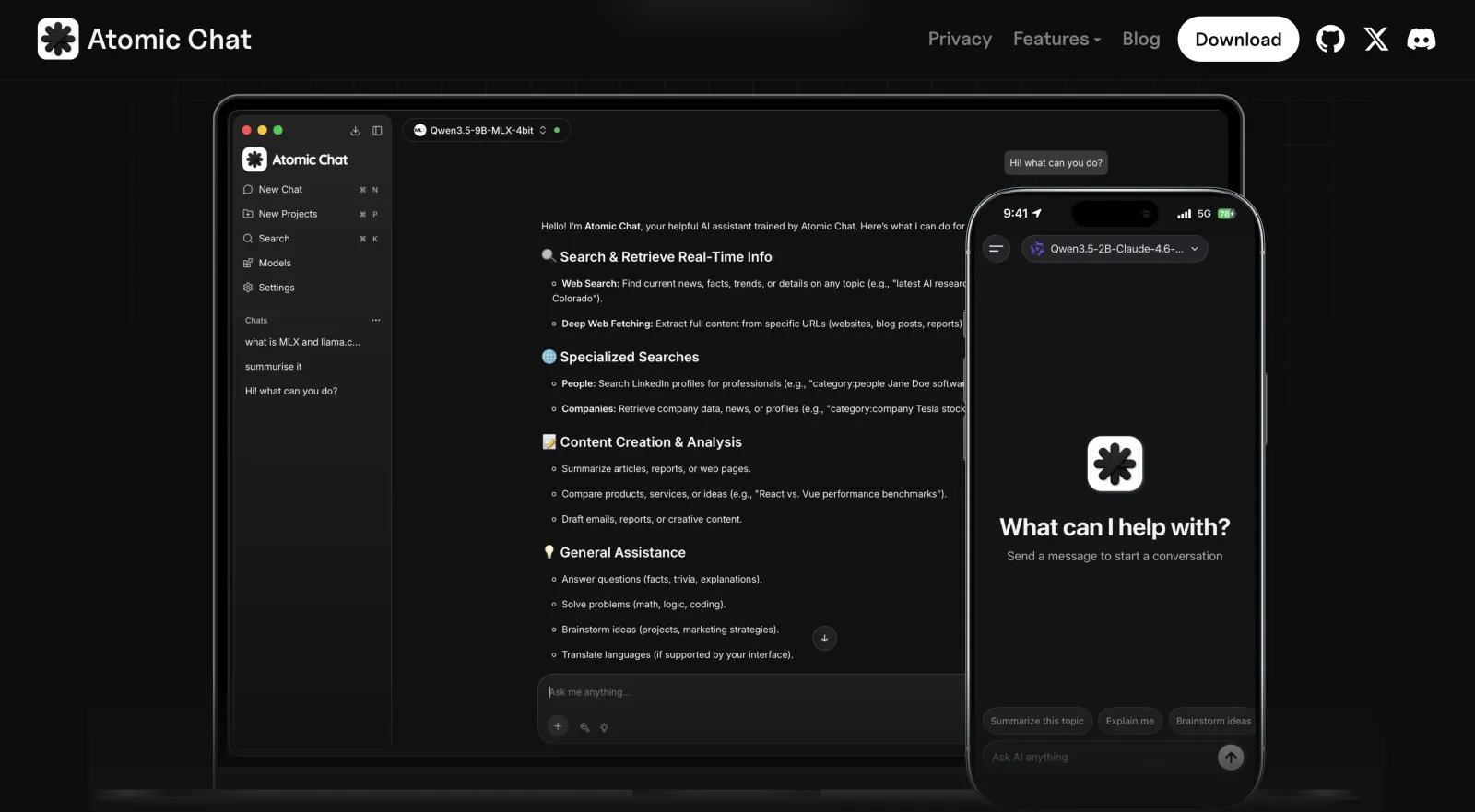
Atomic Chat is a free local AI chat app for Mac, Windows, Linux, iPhone, and Android that allows you to select and run 1,000+ open models from Hugging Face — including the ones we've reviewed above. Atomic Chat runs inference locally on-device, so nothing you type leaves your machine, and there are no rate limits or message caps. It features Google's TurboQuant compression, which shrinks models down to 3 bits with zero accuracy loss and compresses the KV cache by at least 6× — that's how the larger models on this list fit into consumer memory. TurboQuant also computes attention up to 8× faster than standard 32-bit models, and one-click agents like Hermes, OpenClaw, and Cline work out of the box.
Ollama
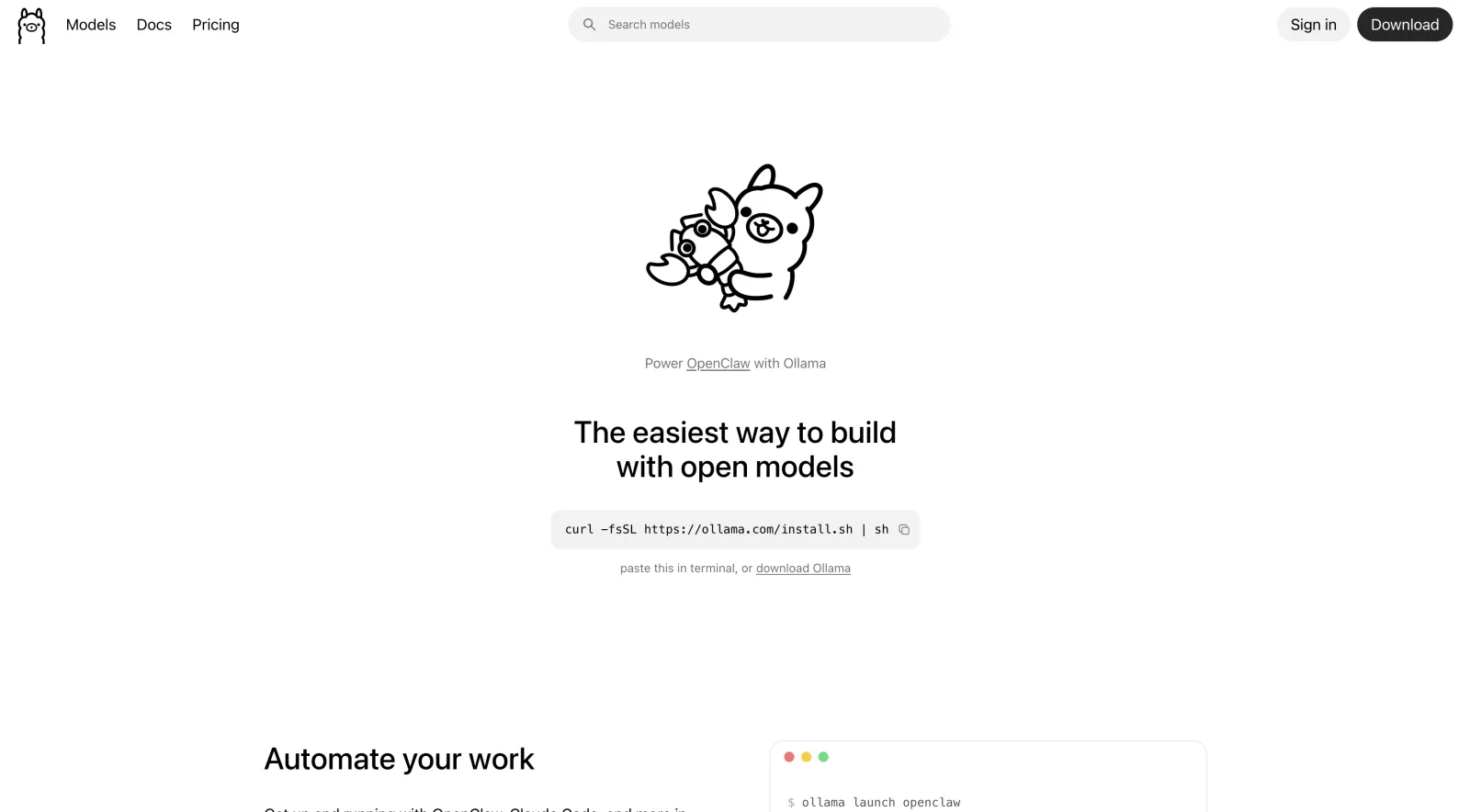
Ollama is an open source tool for running LLMs locally. It downloads and runs models from its own registry with a single command (ollama run qwen3.6) and exposes an OpenAI-compatible API on localhost, which lets other applications use it as a local model backend.
The ollama command also starts an interactive agent that can chat, write code, and search the web, and Ollama integrates with coding agents including Claude Code, Codex, OpenCode, and OpenClaw.
LM Studio
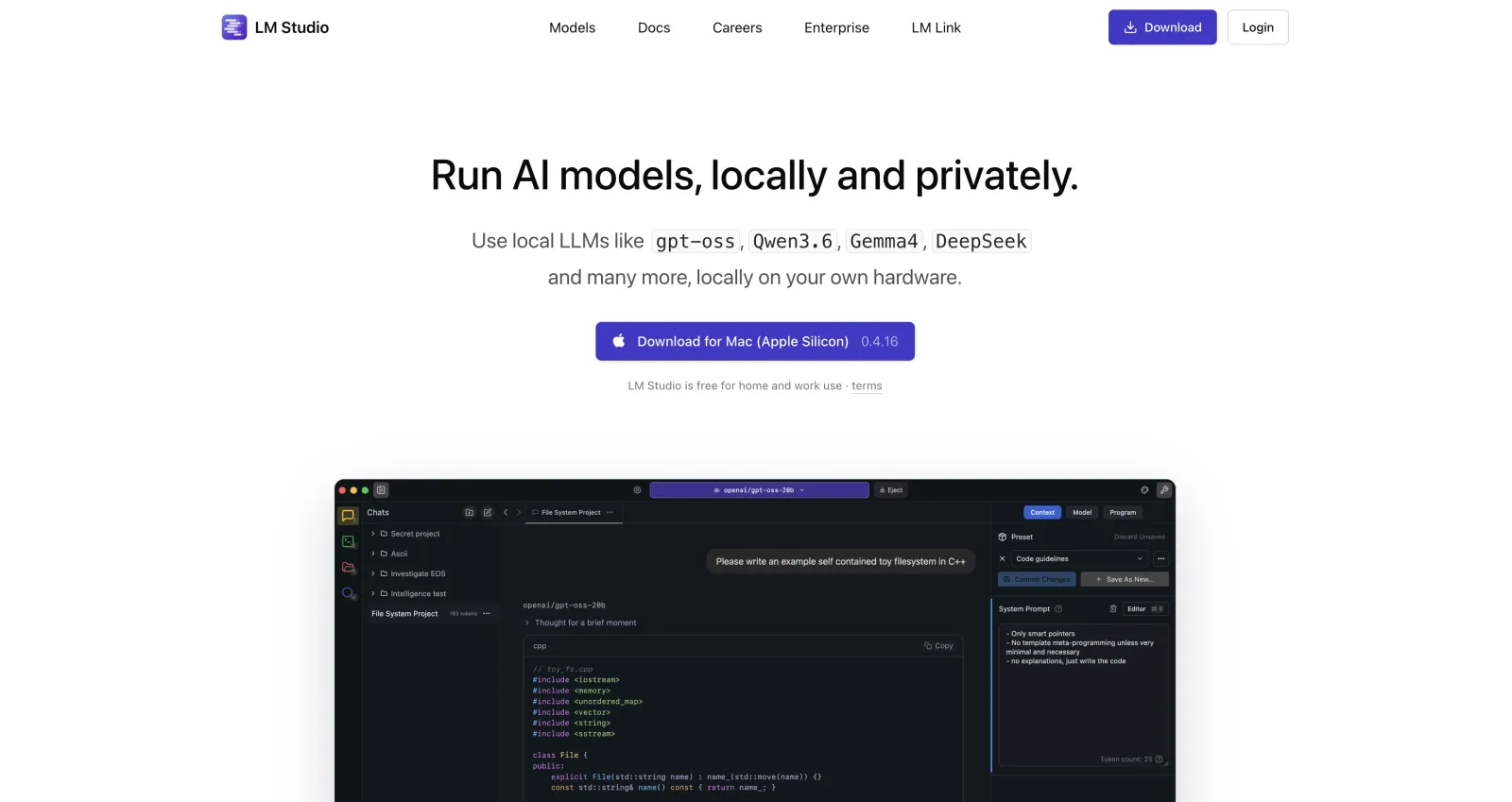
LM Studio is a free, closed-source desktop app for downloading and chatting with models from Hugging Face through a graphical interface. It runs two inference engines: llama.cpp on all platforms, and Apple's MLX on M-series Macs, where LM Studio reports the MLX backend running 30–50% faster than llama.cpp on the same hardware.
It also includes an lms command-line tool and a local OpenAI-compatible server, so other applications can use it as a backend. Recent MLX updates added prompt caching for vision models and KV-cache checkpointing for long sessions.
llama.cpp
llama.cpp is an open source C++ inference engine, started by Georgi Gerganov in 2023. Ollama and LM Studio are both built on it, and it created the GGUF model format used across local tools. It runs on CUDA, Apple Metal, Vulkan, AMD ROCm, and CPU.
It runs from the command line and supports quantization down to 1–2 bits and layer-by-layer GPU offloading, which lets it run models larger than available VRAM by keeping some layers in system RAM. Support for new model architectures usually appears here before the GUI tools.
vLLM
vLLM is an open source inference server for running LLMs on server hardware. It's optimized for serving many simultaneous requests rather than single-user local use, using PagedAttention and continuous batching to keep the GPU utilized under load. Most commercial inference providers run vLLM.
It supports FP8, NVFP4, MXFP4, INT4, and GGUF quantization, and multi-GPU tensor and pipeline parallelism, which is required to run the largest models on this list across several GPUs.
FAQ
A few common questions about choosing and running open source LLMs in 2026.
What is the best open source LLM right now?
GLM-5.2 is the best open source LLM as of July 2026 — it leads open models on GPQA Diamond (91.2) and agentic benchmarks under a clean MIT license. For running on your own hardware, Qwen3.6-27B is the better answer, since GLM-5.2's 753B parameters put it out of local reach.
Is ChatGPT open source?
No. ChatGPT and the GPT-5.x models behind it are proprietary. OpenAI's open-weight contribution is the separate gpt-oss family (120B and 20B), released under Apache 2.0 — capable models, but well behind ChatGPT's flagships.
Can open source LLMs match GPT-5 and Claude?
On coding and reasoning benchmarks, the gap has closed to a few points — MiniMax-M2.5 beat Claude Sonnet on the OpenHands coding index, and GLM-5.2 scores within range of closed flagships. Epoch AI puts open models about four months behind the closed frontier, and the gap is wider in polish and long-horizon agent reliability than the benchmark tables suggest.
Can I use open source LLMs commercially?
Most of this list, yes — everything under MIT or Apache 2.0 (GLM-5.2, DeepSeek-V4, Qwen3.6, Gemma 4, Hunyuan Hy3, Command A+, gpt-oss) has no commercial restrictions. Community-licensed models like MiniMax-M3 add attribution requirements and revenue thresholds, so read the LICENSE file before shipping.
What is the largest open source LLM?
DeepSeek-V4-Pro at 1.6 trillion total parameters is the largest with published weights. Kimi K3 takes the title at 2.8 trillion once its weights ship on July 27, 2026.
Is LM Studio open source?
No — LM Studio is a free but closed-source desktop app. The engine underneath it, llama.cpp, is open source under MIT, and Ollama is fully open source as well.
What is the best open source LLM for coding?
Kimi K2.7-Code for hosted agentic coding, Qwen3.6-27B for anything you run yourself. We've covered the local options in depth in best local LLMs for coding.
Bottom line
In this article, we've looked at the best open source AI models you can run in 2026. Here are the key takeaways:
- Kimi K3 is the best open model overall, and Qwen3.6-27B is the best local model for running on a laptop, Mac, or PC.
- Most models called open source are really open weight. This means that their weights are public, but the training code and data aren't. For running and deploying the models and even using them commercially this doesn't affect anything — it's just a technical distinction.
- 2026 open models are very powerful. For example, GLM-5.2 and Kimi K3 score within a few points of GPT-5.6 and Claude Fable 5 on most benchmarks.
- The best open weight models are overwhelmingly coming from Chinese labs. On this list, for example, eight of the ten models here come from Chinese labs — Z.ai, DeepSeek, Alibaba, Moonshot, Tencent, and MiniMax. The best non-Chinese open model is NVIDIA's Nemotron 3 Ultra.
The fastest way to run an open weight model locally is to try Atomic Chat, which automatically selects the right quantization for your hardware and runs the model on-device for free.