


Quick answer. Use Claude Code for day-to-day work in a repo. Use Hermes if you want an assistant that takes requests in chat and runs tasks on a schedule. If you need both, Hermes can call Claude Code when a request involves editing code.
Hermes Agent vs Claude Code at a glance
The table compares what each agent is built for, which models it runs, and what it costs.
| Feature | Claude Code | Hermes Agent |
|---|---|---|
| Built for | Editing code, running tests, and reviewing changes in a repo | Taking requests in chat and running scheduled tasks |
| Developer and license | Anthropic · proprietary | Nous Research · MIT |
| Models | Claude. Custom endpoints can run other models without Anthropic support | Hosted and local models via Nous Portal, OpenRouter, Anthropic, or OpenAI-compatible APIs |
| Memory | Project instructions in CLAUDE.md and automatic memory, enabled by default |
Saves notes and user preferences and can search past sessions |
| Skills | Uses SKILL.md files you add |
Uses SKILL.md files you add and can write its own |
| Chat apps | Telegram, Discord, and iMessage while a session is open. Channels is in research preview | More than 20 platforms through one gateway |
| Scheduling | Cloud tasks run up to once an hour, even with your computer off. In research preview | Built-in cron sends results to your chat. The host machine must stay on |
| Price | Paid Claude plans from $20/month or usage-based API billing | Free to install. Model costs depend on the provider. Local models incur no API fees |
Hermes vs Claude Code: which one should you use?
Start from the job you need done. You don't need both agents for every job:
| Job | What to use |
|---|---|
| Repository work | Claude Code on its own |
| Chat-based and scheduled tasks | Hermes without Claude Code |
| Delegating coding while Hermes handles the rest | Hermes and Claude Code together |
When to use Claude Code without Hermes
Claude Code is built for repository work: edits across files, tests, diffs, git, pull requests and IDE integration, all tuned for Claude models. Its defaults are built around one repository.
If Claude Code meets your needs, there may be little reason to add Hermes. It takes upkeep: a model, memory, a chat app and updates. A second brain alone rarely justifies that work. Stick with Claude Code and Cowork until you find a job they can't do.
When to use Claude Code with Hermes
If you already use Claude Code for development, Hermes can take care of tasks outside your repository. For example, you can ask it to:
- Triage email
- Run market research on a schedule
- Send you a morning report
You can also message Hermes from your phone and have it pass coding requests to Claude Code.
Both can run on a local model in Atomic Chat, so you don't need to pay for a model API.
If you want to compare other options, Codex is one of the alternatives to Claude Code, while OpenClaw is another local AI agent that works through chat apps.
Why use Hermes Agent over Claude Code
Hermes combines a self-hosted chat gateway, scheduled jobs and self-written skills. Claude Code has some similar features, but the setup and limits differ:
- It runs a persistent chat gateway on your machine. Hermes connects to more than 20 chat platforms and can run scheduled jobs that send results to your chat. The machine must stay on, so some users run it on a VPS. Claude Code’s Channels bring messages into an open session; its cloud scheduled tasks can run with your laptop closed, at most hourly. Both are in preview.
- You control the setup. Hermes is open source, works with any model, including local models, and stores memory, skills and settings as files in
~/.hermes. Hermes itself cannot ban you from using the software, though a model provider can restrict access to its service. - It writes skills by default. Hermes can write skills to save procedures for repeated jobs. It also has built-in memory: 2,200 characters of notes and 1,375 for your profile, plus search over past sessions.
Hermes has downsides too. It runs terminal commands on its machine and takes orders from chat, so your chat account becomes a key to that machine. Run it on a separate machine or a VPS with narrow access. It also takes the upkeep described above: a model, memory, a chat app and updates.
We tested Hermes Agent and Claude Code
To see how Hermes and Claude Code compare in practice, we asked Hermes to delegate coding tasks to Claude Code, gave both agents the same bug and had Hermes set up a daily Telegram report. Claude Code 2.1.332 and Hermes Agent v0.23.4 both used Qwen3.6 27B (Q4_K_M) in Atomic Chat 2.4.7 on an RTX 4090. With the same model in both, the tests compare the harnesses: the tools, system prompt and work loop each agent puts around the model.
Handing coding tasks to Claude Code
Hermes can take coding requests from Telegram and pass them to Claude Code. That lets you ask for changes from your phone while Claude Code works in the repository. We tested whether Hermes would hand over each task, including follow-up changes.
To do this, Hermes uses its built-in Claude Code skill. We gave Hermes a rule to use the skill for repository work: “Coding work in a repository goes to Claude Code through the claude-code skill. Do not edit code files yourself.”
Then we sent five coding tasks from Telegram without mentioning Claude Code. After the fifth task, we asked for two more changes.
| Task | Handed to Claude Code | Result | Time to reply |
|---|---|---|---|
| 1. Two tests fail, fix the bug | Yes | Done, 6 tests pass | 2 min 1 s |
2. Add sentence_count with tests |
Yes | Done, 10 tests | 64 s |
3. Read words per minute from a TEXTSTATS_WPM variable, add a test |
Yes | Done, 12 tests | 73 s |
4. Make python3 -m textstats README.md work |
Yes | Done, 14 tests | 66 s |
5. Add average_word_length |
Yes | Done, 17 tests | 50 s |
| Follow-up: round to 1 decimal, return 0 for empty text | No, Hermes edited the code itself | Done | 28 s |
| Follow-up: document it in the README | No, docs only | Done | 31 s |
Hermes passed all five initial tasks to Claude Code, starting a separate claude -p run for each one. The skill also supports an interactive session for follow-up work, but Hermes didn't start one. Instead, it handled both follow-ups itself, including the code change we had told it to delegate. The rule therefore guides Hermes but doesn't stop it from editing code.
Two settings decide how the handoff works:
- If you add a rule like this, put it in
~/.hermes/SOUL.md. Hermes can read it there, but Claude Code won't. If both agents read the rule from anAGENTS.mdfile, Claude Code may follow it too and start another Claude Code process. - Also check Claude Code's model settings: it uses its own configuration when Hermes starts it. In our setup, Atomic Chat had already written the local model settings to
~/.claude/settings.json, so Claude Code used the same local model without extra configuration.
Fixing a bug
We gave both agents a repository with six tests, two of which were failing, and asked them to find and fix the bug. Both used the same local model and received the same prompt: “Two tests fail. Find the bug, fix it, and run the tests to confirm they pass.”
Both agents found the cause: a function that calculates reading time rounded the result down instead of up. They fixed it in different ways, and all six tests passed. Their time and token use were close, too.
| Measure | Claude Code 2.1.332 | Hermes Agent v0.23.4 |
|---|---|---|
| Solved | Yes, 6 of 6 tests pass | Yes, 6 of 6 tests pass |
| Fix | math.ceil(words / wpm) |
(words + wpm - 1) // wpm |
| Time | 35.2 s | 34 s (82 s on the first run, while the gateway started) |
| Model requests | 10 | 7 |
| Tool calls | 9 (Bash 5, Read 2, Edit 2) | 9 (terminal 6, read_file 2, patch 1) |
| Input tokens | 91,579 (77,829 from cache) | 87,806 (74,821 from cache) |
| Output tokens | 976 | 891 |
| First request (system prompt and tools) | About 11.8K tokens | About 11.2K tokens |
| Where it stumbled | Called pytest first, which wasn't installed | Called pytest first, then found the system one |
Sending a daily summary to Telegram
Hermes can run recurring tasks and send the results to a chat app. We asked Hermes to send us a daily summary of the files in /root/notes. It created the scheduled job in 14.6 seconds. We then ran the job manually to check it, and Hermes sent a correct summary to Telegram.
You can set up a recurring summary in Claude Cowork too, using its scheduled tasks.
| Measure | Hermes | Claude Cowork |
|---|---|---|
| Runs on | A machine that stays on | Anthropic’s cloud, your computer can be off |
| Model | Your choice | Claude models |
| Results arrive in | Telegram or another supported chat app | Anthropic’s apps |
Costs and Claude subscriptions
If you run both Hermes and Claude Code at the same time, you’ll need to give each one an inference provider: either a local model, like we did, or a cloud API, which charges based on your model and usage. Since we ran both apps using a local model in Atomic Chat, inference didn’t cost us anything.
There’s also the cost of the agents themselves. Hermes is free under the MIT license, while Claude Code is included with paid Claude plans:
| Claude plan | Price |
|---|---|
| Pro | $20 a month |
| Max | $100 a month |
| Ultra | $200 a month |
You can also use Claude Code with API billing. Anthropic estimates that Claude Code costs enterprises about $13 per developer per active day, or $150 to $250 a month.
If you use a cloud provider, token usage will affect your bill. In our bug-fix test, Hermes used 87,806 input tokens and Claude Code used 91,579, most of them cached. Each daily summary took 35,944 input tokens and 325 output tokens. A longer Telegram conversation can use more tokens because Hermes keeps it in one session until you send /new.
Using your Claude plan with Hermes
It depends on which agent uses the plan.
When Hermes starts Claude Code, Claude Code signs in with its own login and plan. Your Claude subscription works with the unmodified Claude Code binary, including when another platform hosts Claude Code. Each claude -p run that Hermes starts draws from your plan’s usage limits.
When Hermes answers with a Claude model itself, there are three ways to connect it:
- Use an Anthropic API key and pay per token.
- Log in with a Claude account on Max with purchased extra usage credits.
- Install the experimental DirectSDK plugin, which bills each turn against your Claude subscription’s Agent SDK allowance.
If you use a Claude account to connect, check Anthropic’s OAuth rules. Claude OAuth login is intended for people who bought a Claude plan and for ordinary use of Claude Code and other Anthropic apps. The usage limits on Pro, Max and Ultra assume ordinary, individual use of Claude Code and the Agent SDK.
How to run Hermes on a local model
Hermes stays on and spends tokens on every turn and every scheduled task: one daily summary in our test took 35,944 input tokens. That makes Hermes the agent worth moving to a local model, while Claude Code can stay on Claude. Anthropic doesn't support Claude Code with non-Claude models.
Choose one of the local models for coding that can call tools reliably. Hermes requires a context window of at least 64,000 tokens, so your computer needs enough memory for both the model and its KV cache. Our Qwen3.6 27B in Q4_K_M (15.4 GB) with a 112,128-token context used about 23 GB of VRAM on a 24 GB RTX 4090.
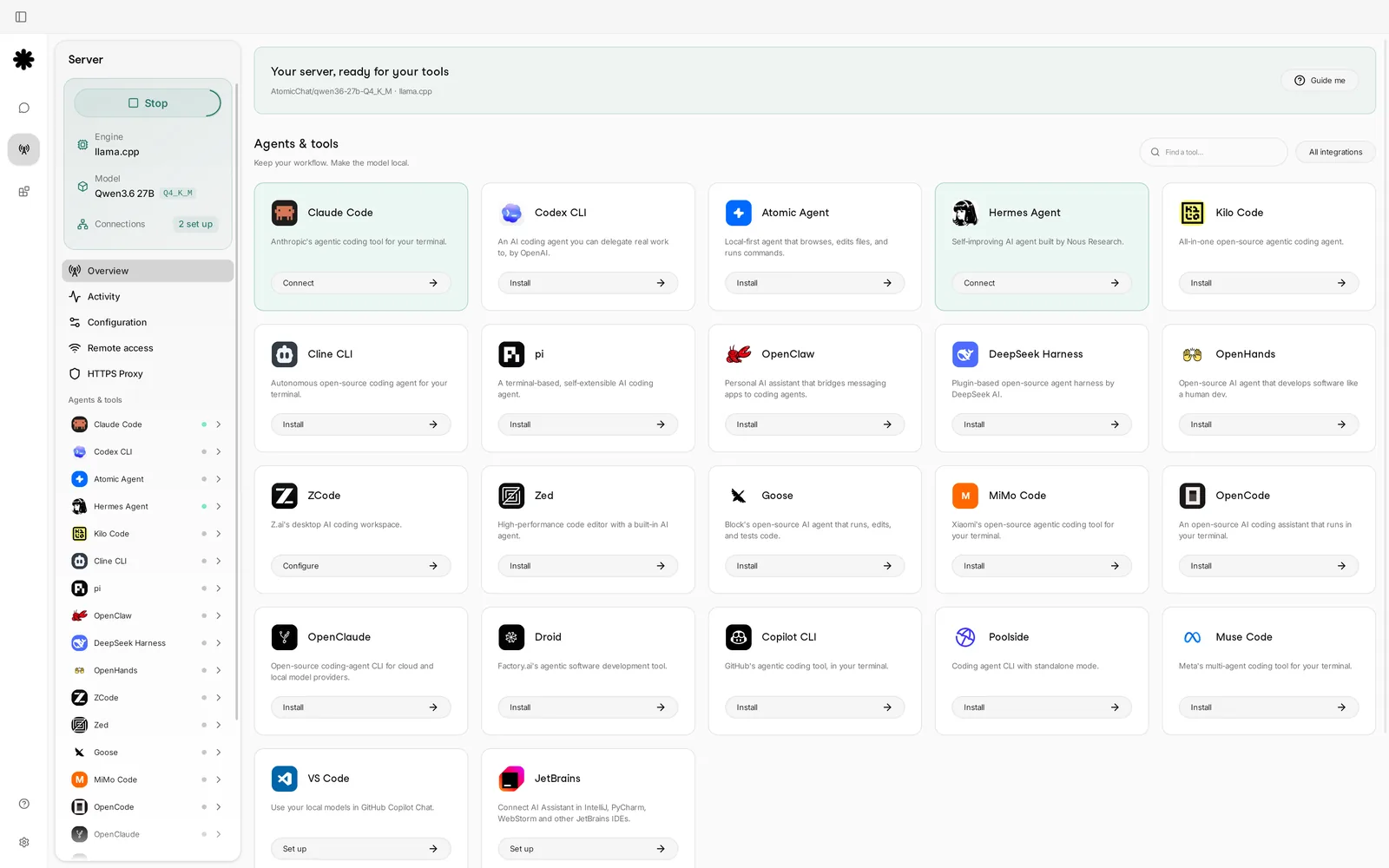
To run Hermes Agent locally, open Integrations in Atomic Chat and click Configure & start on the Hermes Agent card, or Install if Hermes is missing. Atomic Chat starts a local server at 127.0.0.1:1337 and adds it to ~/.hermes/config.yaml as a custom provider, along with the context length. The same page can also run Claude Code locally on that server.
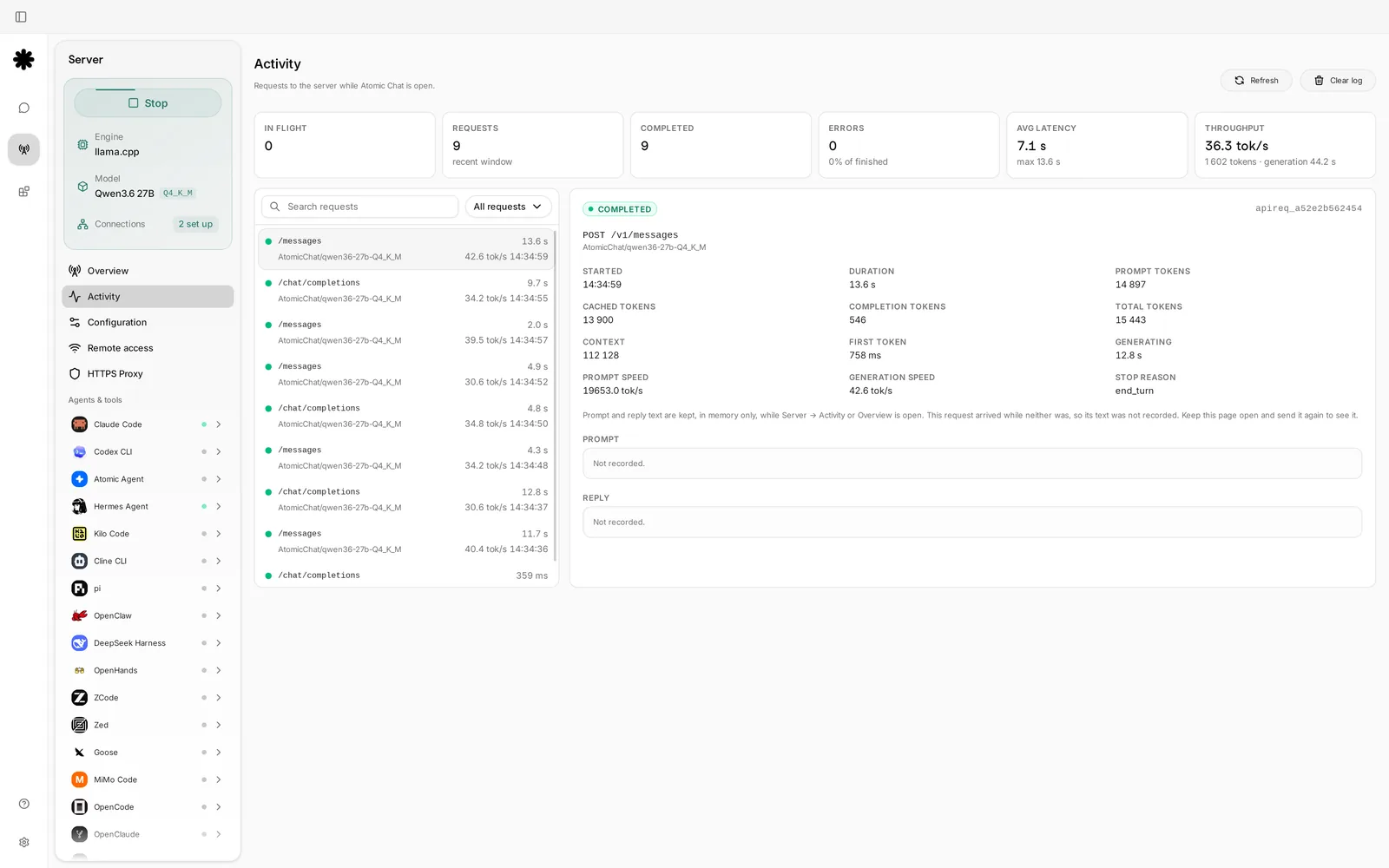
Both agents can share one model. When they answered at the same time, each took up to twice as long as it did alone. Atomic Chat’s Activity page logs every request with its tokens and speed.
Because the model runs locally, prompts, code and replies are processed on your computer rather than sent to a model provider. Messages sent through Telegram or another chat app still pass through that service.
Download Atomic Chat to run Hermes Agent on a local model.
FAQ
Can Hermes Agent run Claude Code?
Hermes can hand coding tasks to Claude Code through its built-in Claude Code skill. In our test, it handed over all five initial tasks, but made a follow-up code change itself.
Is Hermes Agent good for coding?
Hermes can fix code on its own: in our test, it fixed a failing-test bug on a local model in 34 seconds. For repository work, it can also hand tasks to Claude Code through its built-in skill.
Can I use a Claude Max plan with Hermes?
When Hermes starts Claude Code, Claude Code signs in with its own login and plan, and each claude -p run draws from your plan’s usage limits. When Hermes answers with a Claude model itself, it needs an Anthropic API key, a Claude login on Max with extra usage credits, or the experimental DirectSDK plugin.
Is anything better than Claude Code?
It depends on the job. Claude Code is built for repository work on Claude models. Codex is one of the common alternatives to Claude Code, and Hermes covers chat apps, memory and schedules on any model.
Can Claude Code run on a schedule when my computer is off?
Yes. Cloud scheduled tasks run on Anthropic’s servers at most once an hour and are in research preview. Hermes runs scheduled jobs on its host machine, which must stay on. You can use a VPS for that.
Is Hermes Agent free?
Yes. Hermes Agent is open source under the MIT license. You can run it with a local model or pay for a hosted model through a provider or Nous Portal.
Product details checked on November 26, 2026.